
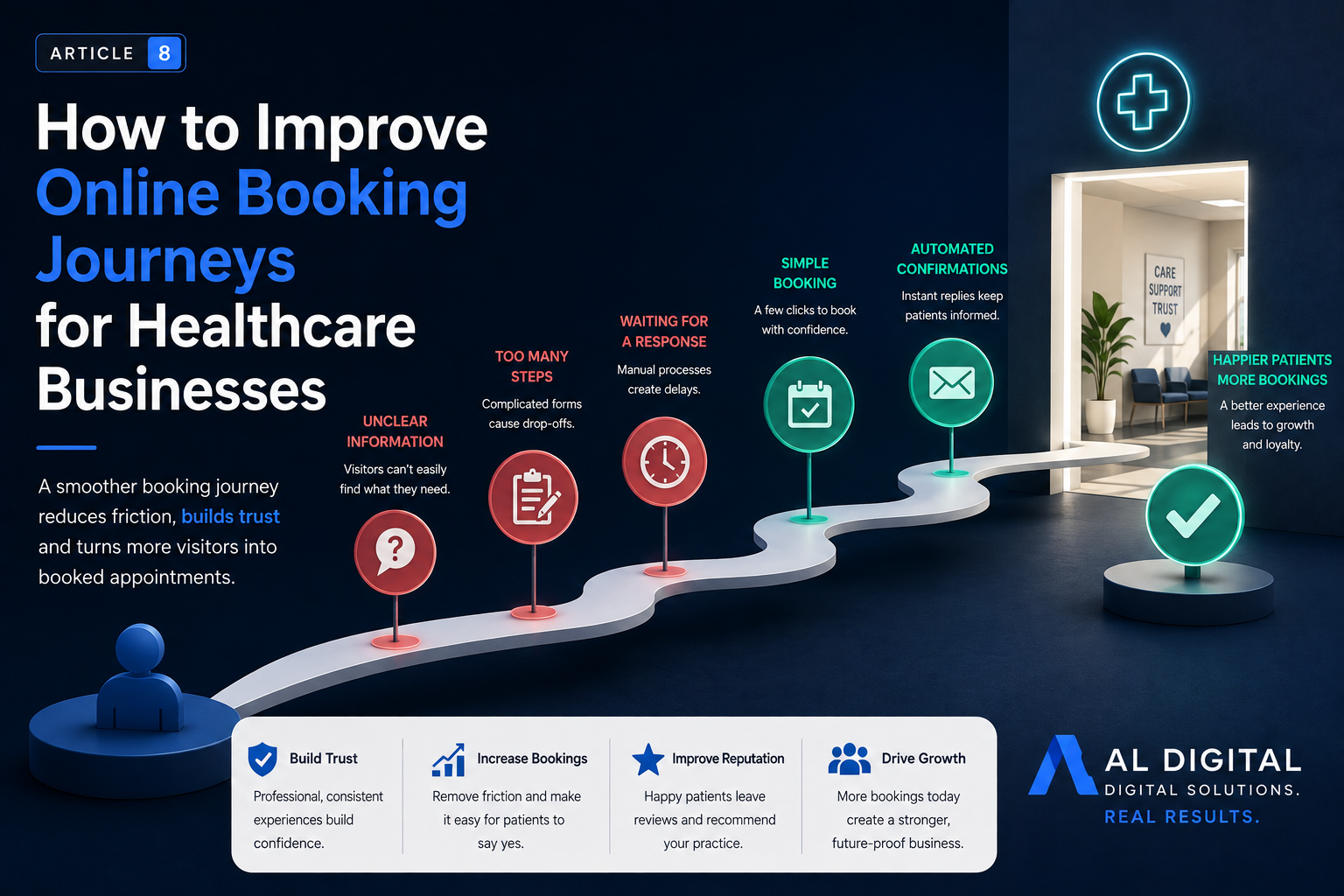
For many healthcare businesses, the booking journey is one of the most important parts of the website.
A patient may already know what service they need and be ready to take the next step. But if the journey involves unclear information, several platforms, long forms, phone calls, external handoffs or waiting for someone to respond, unnecessary friction is introduced at the point of highest intent.
A good booking journey should make it easier for patients to:
The objective is not simply to put a booking calendar on a website. It is to create a clear, trustworthy journey around the patient and the service being provided.
What Is an Online Booking Journey?
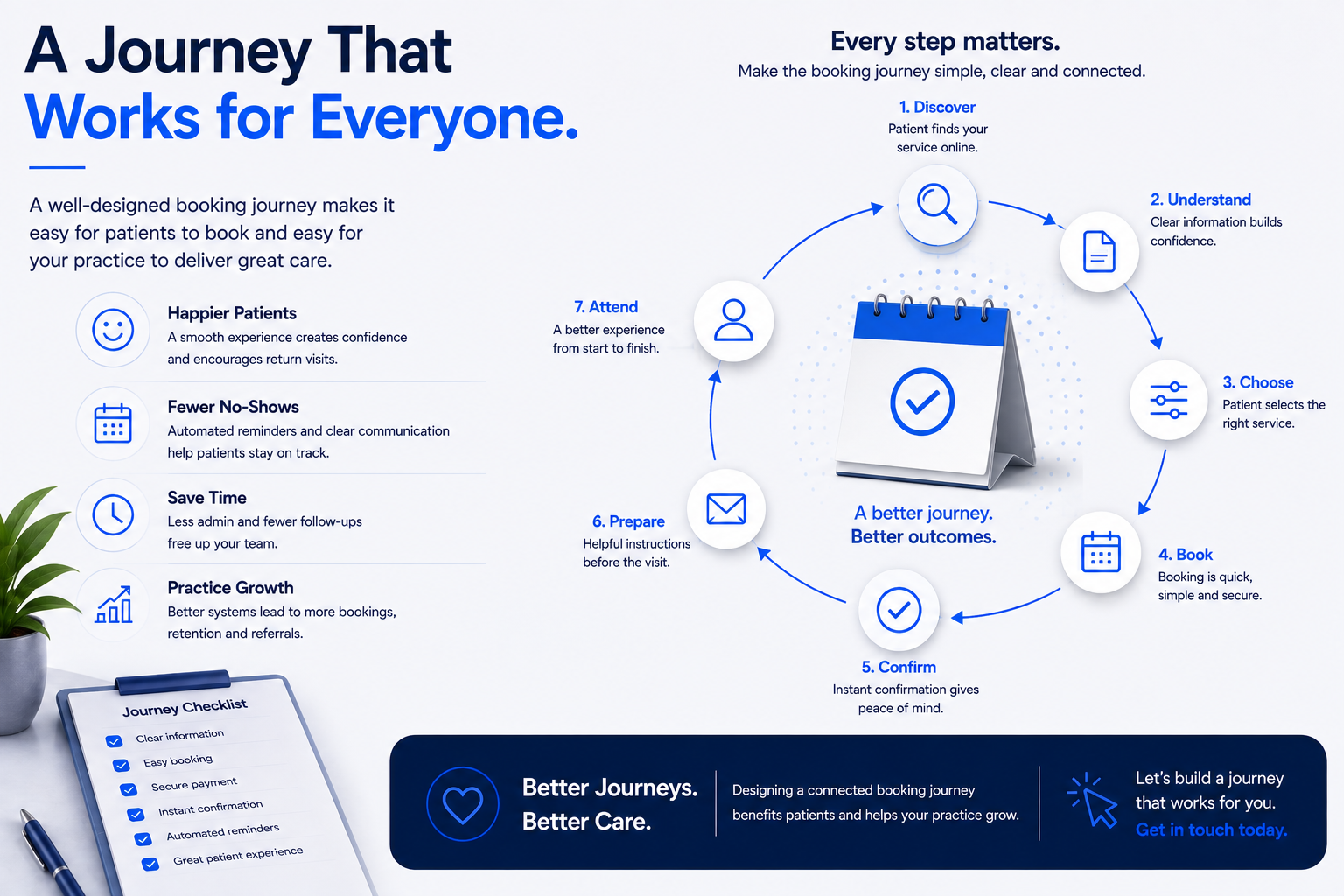
An online booking journey includes every step between a patient becoming interested in a service and receiving confirmation of their appointment.
For example:
Service page → eligibility information → appointment selection → patient details → confirmation
For another healthcare business it may be:
Service page → short consultation form → clinical review → appointment → payment → confirmation
There is no single correct structure. The right journey depends on the service, clinical requirements, patient information needed, whether payment is required, whether eligibility must be assessed and whether the appointment can be booked instantly.
The goal is to make the process appropriate without making it unnecessarily complicated.
Where Healthcare Booking Journeys Commonly Break Down
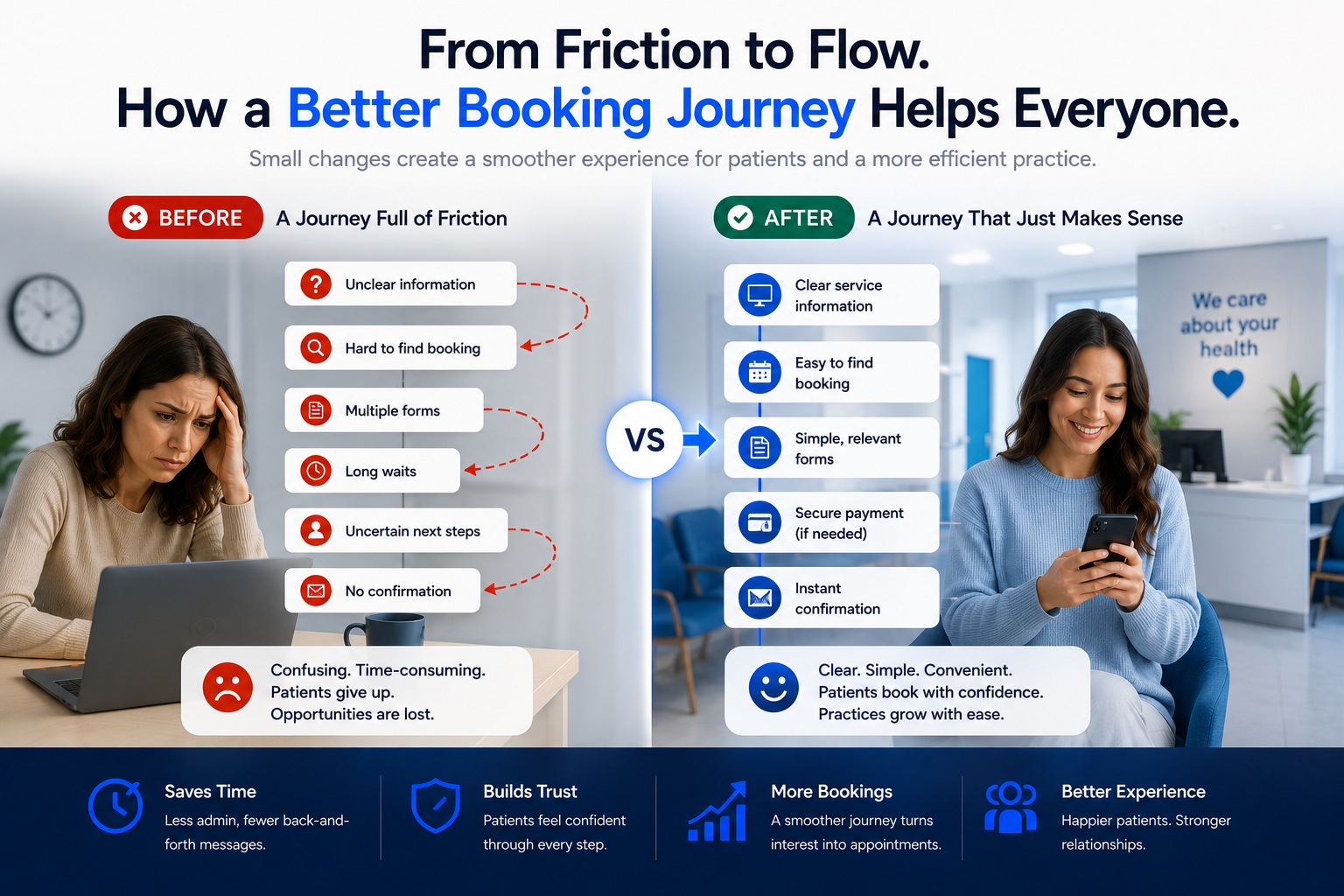
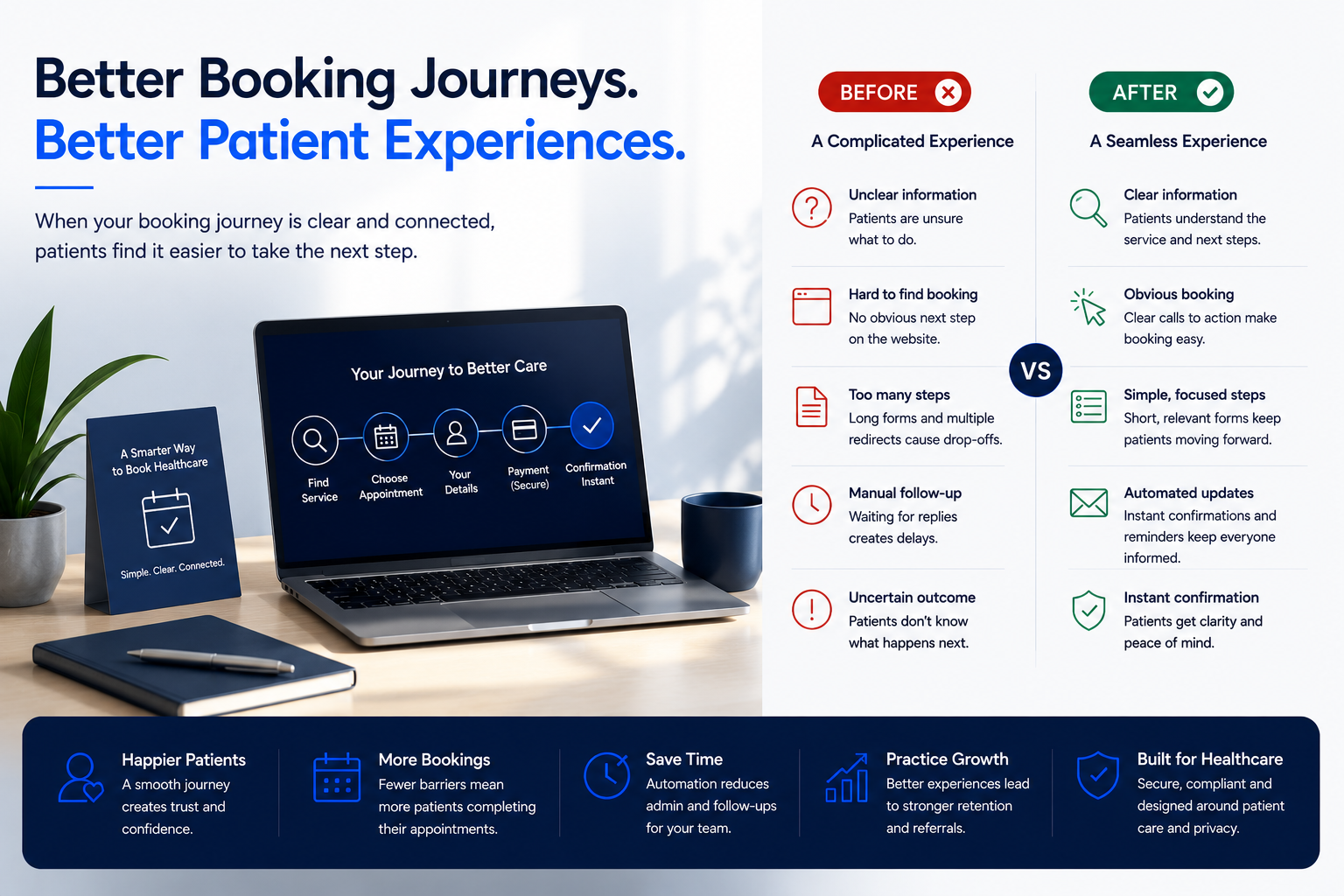
Typical problems include unclear service information, no obvious booking button, competing calls to action, unnecessary calls or emails, multiple platforms, duplicate forms, unclear prices or eligibility, slow manual confirmation, missing confirmation emails and a poor mobile experience.
Each individual issue may seem small. Together, they can make the journey feel difficult or uncertain.
Start With Clear Service Information
Before asking someone to book, make sure they understand what they are booking.
A strong healthcare service page should usually explain:
- what the service is
- who it is suitable for
- important eligibility information
- what happens during the appointment
- relevant pricing
- what happens afterwards
- how to book
Patients should not have to search several different pages to understand the basics. Clarity before booking helps reduce uncertainty later in the journey.
Our guide to what a healthcare website should include covers the wider content, trust and functionality foundations.
Give Patients an Obvious Next Step
Once a patient understands the service, the next action should be easy to identify.
Depending on the service, that might be:
- Book Appointment
- Check Availability
- Start Consultation
- Request an Appointment
- Speak to the Clinic
Avoid using several competing calls to action unless there is a genuine reason. The patient should know: “This is what I do next.”
This is one part of the wider website customer journey, where clarity and trust help interested visitors take the next appropriate step.
Instant Booking vs Request-to-Book
Instant booking can work well when:
- the service is straightforward
- eligibility is simple
- the patient can choose an appropriate appointment themselves
- little or no clinical triage is required beforehand
Request-to-book may be appropriate when:
- clinical suitability needs reviewing
- complex information must be collected first
- the correct practitioner needs to be selected
- additional assessment is required
The problem is not request-to-book itself. The problem arises when patients do not understand why they cannot book immediately, what happens after submitting, how long they are likely to wait or when they will receive confirmation.
If manual review is necessary, explain the process clearly.
Reduce Unnecessary Platform Handoffs
Healthcare websites often rely on third-party booking tools. There is nothing inherently wrong with this. The issue is whether the handoff creates confusion or loss of trust.
Healthcare website → external booking provider → consultation form → payment system → email confirmation
This may feel fragmented if each stage appears unrelated.
Where external systems are necessary:
- maintain consistent branding where possible
- explain what is happening
- make the transition clear
- avoid asking for duplicate information
- return the patient to a clear confirmation state
The patient should feel like they are completing one journey, even if several systems sit behind it.
Keep Forms Appropriate to the Stage
One of the easiest ways to create friction is asking too much too early. Before someone has decided to book, a long form can feel disproportionate.
Separate information required to make an enquiry from clinical information genuinely required before the appointment.
Where appropriate, an initial booking form may only need:
- name
- contact details
- selected service
- preferred appointment
- a small amount of relevant information
More detailed information can then be collected at the appropriate stage. Healthcare businesses should always collect information according to their clinical, privacy and regulatory requirements.
Do not simplify forms in a way that removes genuinely necessary patient information.
Make Pricing Clear Where Appropriate
For private healthcare services, uncertainty around price can create unnecessary hesitation.
Where suitable, clearly communicate consultation cost, service price or starting price, deposits, whether payment is required when booking and relevant cancellation terms.
Not every service can have a simple fixed price. If pricing varies, explain why and what the patient can expect.
Clarity is usually better than making patients enquire just to discover basic cost information. The AL Digital pricing page similarly shows how transparent starting points can frame a more detailed discussion.
Connect Booking and Payment
Where payment is appropriate, consider whether it can form part of the same customer journey.
Service → Appointment → Payment → Confirmation
or:
Consultation request → approval → payment → appointment confirmation
Connected payment journeys can reduce manual administration and make the process clearer for both patient and business. However, payment design should reflect the nature of the service and the healthcare provider’s own requirements.
Confirmation Matters
A booking journey should not end with a vague “form submitted” message.
Patients should understand whether they have a confirmed appointment, submitted a request, need to take another action, should expect a phone call, need to complete additional information or have successfully paid.
Confirmation can include:
- on-screen acknowledgement
- email confirmation
- appointment details and location
- preparation instructions
- cancellation information
- calendar options
The clearer the confirmation, the less uncertainty the patient has after booking.
Use Automated Reminders Carefully
Automation can support booking confirmations, appointment reminders, preparation instructions, follow-up messages and requests to complete forms.
The purpose should be to make the patient experience clearer and reduce unnecessary manual administration. Do not automate communication simply because the technology allows it. Every message should have a clear purpose.
Mobile Experience Is Critical
Many patients will discover and book healthcare services from a phone. Test the complete journey on mobile.
Check whether patients can comfortably:
- understand the service
- see pricing
- tap the booking call to action
- select an appointment
- complete forms
- make payment
- read confirmation details
A booking system that technically works on mobile can still be frustrating if buttons, forms or content are difficult to use.
Build Trust Throughout the Journey
Booking healthcare is different from buying an ordinary consumer product. Patients may be sharing personal information or making decisions about their health.
Trust signals can include practitioner information, qualifications, clinic details, transparent pricing, professional presentation, clear contact and privacy information, consistent branding and a secure payment experience where relevant.
Trust should remain consistent from the service page through to booking and confirmation. Explore our healthcare digital solutions for a broader view of connected websites, booking journeys and operational systems.
Measure the Booking Journey
Healthcare businesses should understand what is happening within the journey.
Useful measures may include:
- service page visits
- booking call-to-action clicks
- booking starts
- completed bookings and enquiry forms
- booking abandonment
- device type
- traffic source
Tools such as Google Analytics and Microsoft Clarity can help identify where users appear to struggle. Do not assume every drop-off means something is broken. Use data alongside actual customer behaviour and business context.
If a wider website is underperforming, review the common reasons a business website may not generate enquiries.
A Better Booking Journey Can Also Reduce Admin
Improving the patient experience can also make internal processes easier.
A connected journey may reduce repeated phone calls, manual appointment confirmation, copying patient details between systems, unnecessary email back-and-forth, avoidable booking questions and manual payment chasing.
This matters because digital improvements should support both sides of the process:
patient experience + business operations
See the wider AL Digital services for websites, integrations, payments, automation and ongoing optimisation.
Healthcare Booking Journey Checklist
Review the current journey and ask:
- Can patients understand the service easily?
- Is the next action obvious?
- Is eligibility explained?
- Is pricing clear where appropriate?
- Can suitable patients book directly?
- If manual review is needed, is the process explained?
- Are patients sent through unnecessary external steps?
- Are forms appropriate to the stage?
- Is information requested more than once?
- Does the booking journey work well on mobile?
- Does the patient receive clear confirmation?
- Are reminders and follow-up communications useful?
- Are booking completions being measured?
- Is staff administration higher than it needs to be?
If several answers are no, the booking journey may be worth reviewing.
The Goal Is a Connected Patient Journey
The best booking system is not necessarily the one with the most features. It is the one that fits the service and makes the process understandable for both the patient and the healthcare business.
A strong journey connects service information, patient decisions, booking, required information, payment, confirmation and follow-up. The technology should support the process rather than becoming another obstacle within it.
Is Your Healthcare Booking Journey More Complicated Than It Needs to Be?
AL Digital builds websites and connected digital systems around patient journeys, bookings, enquiries, payments and business workflows.
Explore Healthcare Solutions Get a Free QuoteExplore more practical guidance in the AL Digital Insights hub.